

A client in Mexico will pay on Thursday. The money arrives Tuesday – minus a wire fee, minus a currency conversion cut, minus whatever the intermediary bank took along the way. For a small business that doesn’t have much money, the gap between when a customer pays and when the money actually arrives hurts. It’s a cash-flow problem that repeats every month.
Paying using crypto doesn’t solve all the problems in international business. But for specific problems–slow settlement, high transfer fees, customers in markets where card infrastructure is unreliable–they offer a practical alternative that more small businesses are quietly adding to their payment options. It’s not meant to replace cards or bank transfers, but as an extra option.
Why Small Businesses Are Exploring Crypto Payments
Traditional international payments have three problems. These problems will not get smaller as your business grows. First, delays occur when money moves between banks. A SWIFT transfer between two banks in different countries usually takes one to five working days, and that’s if everything goes to plan. Second, transfers face restrictions. Some corridors are expensive or unreliable. For example, you often pay fees when paying a supplier in Southeast Asia or receiving money from a customer in Latin America. These fees can add up to several percent of the total. Third, currency conversion costs add up. The difference between the rate shown and the actual rate is usually unclear, and it gets worse every time money moves between currencies.
If you’re a business owner who has paid international suppliers or invoiced clients abroad, you’ll already be familiar with this. What has changed is that the infrastructure for crypto payments is now simple enough for a small business to use without a technical team. A payment platform handles wallet addresses, confirmation monitoring, and conversion–the business owner sees an invoice and a payout, much like with a card processor.
How Crypto Payments Work for Small Businesses
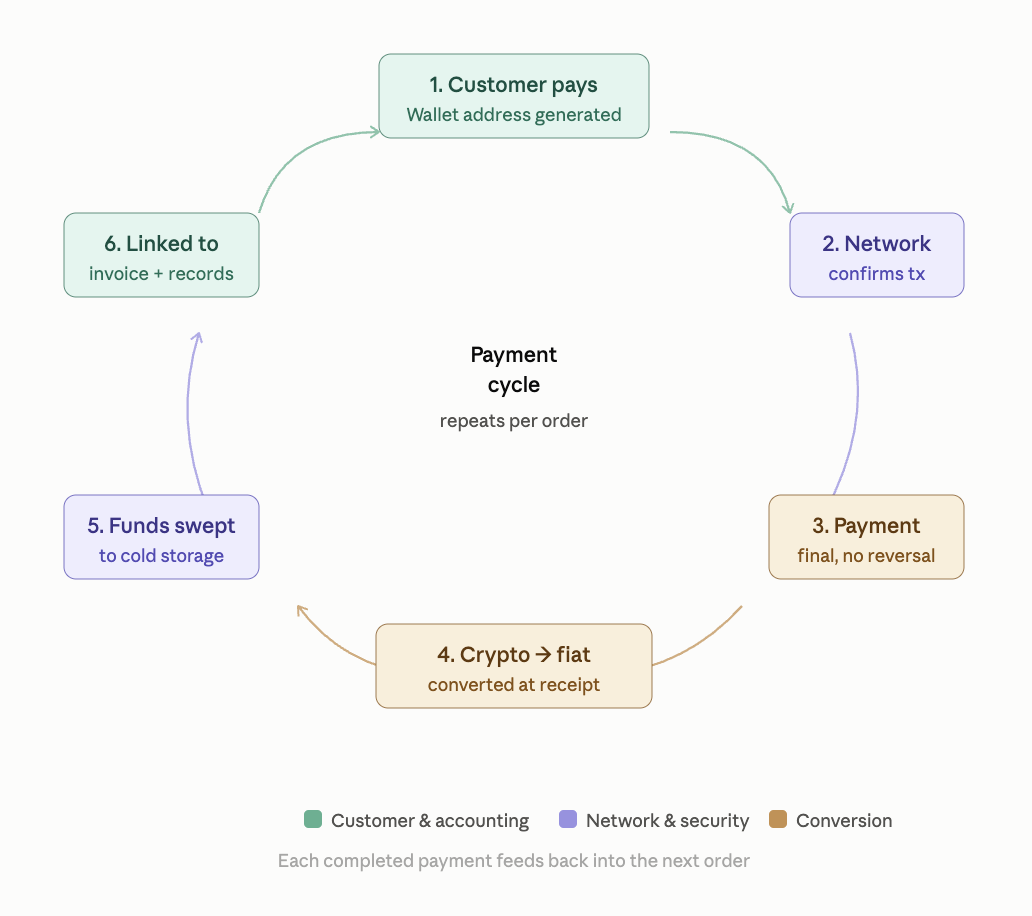
The basic process is simpler than most people expect. A customer can pay with crypto at checkout or on an invoice. The payment platform will generate a wallet address and an amount. The customer sends money from their own wallet. The blockchain network confirms the transaction, which takes seconds on faster networks and up to thirty minutes on Bitcoin. This means the payment is complete. The business then decides whether to hold on to the crypto, convert it to local currency, or send it directly to a supplier.
What happens behind that depends on whether you use a payment processor or manage wallets directly. A processor handles address generation, confirmation tracking, and settlement – you get paid in your local currency at regular intervals, like a card acquirer. Managing wallets yourself gives you more control over timing and reduces fees at higher volumes, but it puts every operational step on your team.
Accepting Payments from Customers
If you have an online store, you can accept crypto by installing a payment plugin that connects your checkout to a crypto payment platform. Customers can choose Bitcoin, USDC, or other supported currencies alongside card options at checkout. They pay directly, the platform confirms the transaction, and the order is completed. Most online platforms used by service businesses that send invoices let you create a payment link or QR code that does the same thing.
The confirmation is the settlement. With a card payment, you can usually reverse the transaction weeks later, but you can’t with a confirmed blockchain transaction. For businesses that sell digital goods or have experienced card fraud, this finality matters. But there is a problem: if you send something to the wrong address or pay for the wrong network, it’s permanent.
Converting Crypto into Fiat Currency
Most small businesses don’t want to hold crypto. They want to receive it and convert it to the currency they use to pay their rent and salaries. Off-ramp solutions handle this conversion when you receive it or on a schedule that you set – crypto comes in, local currency goes out to your bank account.
Stablecoins make this easier to predict. USDC and similar assets are linked to the US dollar, so a payment of 500 USDC is 500 dollars whether you convert it today or next week. Many businesses that work in international markets use stablecoins because they are as fast as crypto payments but less risky than holding Bitcoin or Ethereum. If a customer pays in USDC on a Tuesday, you know exactly what you’re getting before you decide when to convert it.
Key Benefits of Accepting Crypto Payments
The advantages are practical, not theoretical. They show up in cash flow and in the conversations you have with customers about late payments.
- It’s quicker to settle. Crypto transactions are confirmed in minutes or hours, not days. For a business that invoices clients on net-30 terms, getting paid faster means having more money available to use in the business.
- Transferring money internationally will cost less. Network fees on most blockchains are very low, usually just a few cents per transaction. If you stop using the banks that your money is sent through, you can stop paying extra fees.
- No chargebacks. Once a blockchain transaction is confirmed, the customer’s bank cannot reverse it. This is good news for businesses that sell digital goods or have dealt with card fraud, as it helps them avoid extra costs and paperwork.
- This means you can sell your products in more markets. People in countries where cards are hard to use, or where currency controls exist, can pay with crypto, even if card payments don’t work or are blocked. This means they can sell to markets that are usually difficult to reach.
- It is open 24/7. The blockchain doesn’t follow business hours or bank holidays. If a customer pays on a Sunday night or a public holiday in their country, it won’t delay you.
- Transparent transaction records. Every payment is recorded on a public ledger with a unique code and a timestamp. If you run a business that needs to handle international payments in different currencies, the records are clear and immediate.
Risks and Challenges to Consider
Adding crypto payments makes things more complicated than using cards. There are real benefits, but so are the risks. A small business should be honest about both before spending money on the setup.
Volatility, Security, and Regulatory Compliance
The biggest risk is price swings. If you receive Bitcoin as payment, it can lose up to ten percent of its value before you convert it. Stablecoins reduce this risk significantly, but don’t eliminate it. Some stablecoins are linked to a dollar anchor, but this can cause real losses. The best approach for most small businesses is to convert crypto into fiat (regular money) as soon as they receive it.
Security is more complicated than setting up a card payment. The system that receives your payments needs to have strong access controls. This means individual logins for each team member who uses the system. It also means two-factor authentication on every account and approval requirements for outgoing transfers above a certain amount. One hacked admin account with total access is a much bigger risk in crypto than in regular banking, because transactions cannot be reversed.
Rules and laws about how to run a business differ by country and are still changing in most places. In many places, you have to pay tax on any cryptocurrency you receive. This tax is based on the price of the cryptocurrency when you receive it. If you convert crypto to fiat, you may have to pay tax on it again. Rules exist to prevent money laundering (AML) and identify who is buying crypto (KYC). These rules differ by country. If you want to start accepting crypto payments, it’s a good idea to talk to a tax advisor or legal professional who knows the rules in your country. Crypto payments have different rules than card payments so that you may need different advice for your business.
Fraud prevention works differently. There are no chargebacks, which reduces card fraud. Still, crypto scams exist in other forms: phishing attacks that redirect payments to attacker-controlled addresses, clipboard-hijacking malware that replaces a copied wallet address, and social engineering attempts targeting whoever controls your payment accounts. You can take a few simple steps to reduce the risk of your money being stolen. These include keeping a verified address book, testing transactions before sending large amounts of money, and allowing only certain people to authorise outgoing transfers.
Best Practices for Implementing Crypto Payments
The difference between a crypto payment setup that runs smoothly and one that creates problems almost always comes down to the planning done before the first transaction. Most problems, like security problems, money problems, and problems with rules, are easier to stop than to fix after they happen.
Choose a Secure and Reliable Payment Provider
The payment platform you choose determines how much operational complexity sits with your team and how much sits with the provider. Before choosing one, make sure it ticks all the boxes for a small business that doesn’t have much money:
Cryptobanco is built for businesses that need crypto payment infrastructure at the operational level: treasury management, cross-border payouts, and the compliance layer that working across multiple countries requires. No matter which provider you use, you can do a few things to reduce the risk of things going wrong. Keep only what current orders require in the checkout wallet–don’t let balances build up where your website can access them. Make a list of the people in your team who can approve outgoing transfers. Also, set up a second approval process for amounts above a threshold you define. Make sure you fully verify wallet addresses before sending money, not just the first and last few characters. Malware that hijacks clipboards is common right now, and if you check only part of the address, you might miss it.
The following table shows the main decision areas and what happens if you skip them:
|
What to set up |
What goes wrong without it |
|
Separate checkout and treasury wallets |
A compromised checkout wallet reaches your full business reserves |
|
Individual logins, no shared accounts |
After an incident you can’t tell who authorized what |
|
Two-factor authentication on every account |
A stolen password gives full access to payment functions |
|
Second approval on large outgoing transfers |
One compromised account can move funds without a check |
|
Full address verified before every send |
A clipboard-hijacked address means permanent loss |
|
Transaction IDs linked to invoices and orders |
Without this link you’ll spend hours matching payments to invoices by hand once volume picks up |
|
Fiat conversion at point of receipt |
Volatility exposure on every payment you hold in crypto |
|
Tax and compliance review before launch |
Taxable events go unrecorded; AML obligations missed |
Setup checklist for small businesses adding crypto payments. Rules vary by jurisdiction – verify compliance requirements with a qualified advisor.
Final Thoughts
Crypto payments can help small businesses in some situations: for example, when they have international clients in markets where cards are unreliable, when suppliers prefer crypto, or when customers already pay from wallets. They are also useful for businesses where chargeback risk on card payments is a real operational cost. In most other situations, the extra complexity might not be worth the effort.
Before adding crypto as a payment option, think about the actual problem you’re trying to solve. If it’s slow international settlement, check whether the markets you serve and the crypto networks your customers use actually match. If it’s high transfer fees, compare the total cost of a crypto payment setup with what you’re currently paying. Platform fees, conversion spreads, and compliance costs all count. If it’s what customers want, find out if they’re asking for it or if you think they need it, even if they don’t.
The businesses that get the most out of crypto payments are the ones that start with a clear problem, choose a platform that fits their actual volume and compliance needs, set up the access controls and accounting links before the first transaction, and treat it as part of their payment infrastructure rather than a separate experiment. Start with one corridor or one customer segment, get the operational layer right, and expand from there.