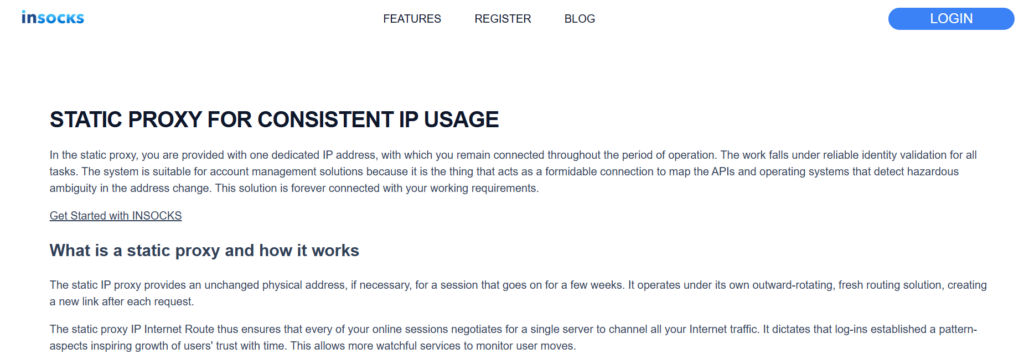
Modern online operations often depend on repeatable access rules rather than on constant IP changes. For teams that work with allowlisted APIs, admin panels, payment services, and monitored business tools, a static proxy can become a controlled access instrument instead of just a network add on. On the INSOCKS page, static access is presented as one dedicated IP that remains unchanged during the working period, which makes it relevant for predictable identity validation and long session workflows. The practical value appears when that fixed endpoint is tied to cleaner setup habits, safer credentials, and a disciplined review cycle. ✨
Why fixed endpoints matter in controlled systems
A fixed IP matters most when the destination expects continuity. Many internal tools and protected public systems react badly to repeated address shifts, even when the user credentials remain valid. In those environments, a static route becomes part of the access policy itself, not just a transport method.
|
Access environment |
Why a fixed IP helps |
Practical effect |
|
API allowlists |
Endpoint can be registered once |
Fewer repeated whitelist changes |
|
Payment systems |
Session changes can trigger extra checks |
More stable access continuity |
|
Enterprise dashboards |
Platforms may react to abrupt IP shifts |
Lower interruption during long tasks |
|
Account management |
Consistent login history matters |
Cleaner account behavior patterns |
|
Admin tools |
Stable origin simplifies permission design |
Easier internal control |
API access works better with one approved origin
The page states that static proxies are suitable for API access when endpoint allowlisting is required and when stable links are needed for automation. In practice, this means a team can register one predictable source rather than updating access policies every time the IP changes. For workflows built around scheduled jobs or repeated API calls, that reduces maintenance noise. ✅
Payment systems prefer predictable behavior
INSOCKS lists payment systems and financial platforms among the cases where fixed solutions are the right choice. These services often react strongly when a session changes its visible network identity in the middle of ongoing work. A fixed address can therefore support smoother continuity during sensitive operational tasks.
How INSOCKS frames static access
The service page describes one dedicated IP address that remains connected for the period of operation and says fixed solutions can work for sessions lasting hours, days, or even weeks. It also positions the product as lower cost than residential or mobile options because it uses a different infrastructure model. That makes the service attractive for teams that want predictability without paying for rotating residential complexity.
Dedicated IPs change the maintenance burden
INSOCKS says each static address works as a dedicated connection and is not shared with other users. This matters because a private endpoint is easier to assign to one account group, one automation flow, or one allowlisted environment. Shared routing usually creates more ambiguity than controlled operations want.
Datacenter speed stays part of the offer
The page presents predictable performance and datacenter routing speed as part of the benefit profile for static proxies. That means the service is not framed as a slow security tool but as a stable route that still keeps performance practical. For business dashboards and API work, that balance often matters more than maximum concealment.
Comparing static access with other proxy types
A fixed endpoint is not automatically better than every alternative. The product page compares static proxies with residential and mobile options and explains that the right choice depends on the task. The useful part of that comparison is how clearly it separates continuity from broader trust or higher mobility.
|
Proxy type |
Strength in controlled access work |
Main drawback |
|
Static |
Full session control and stable endpoint identity |
Lower trust than genuine home connections on some platforms |
|
Residential |
Higher trust from real home user space |
Less suited when one exact endpoint must stay constant |
|
Mobile |
Highest trust for strict anti fraud environments |
More expensive and less practical for broad allowlist use |
Static routes outperform rotation in allowlisted setups
The page says dedicated endpoint options are the right pick for account management, while large scale data collection is better suited to residential solutions and strict anti fraud bypass is better suited to mobile solutions. This is a useful reminder that allowlists and controlled admin access usually need sameness, not variety. A system that expects one registered origin should not be fed a rotating identity.
Residential access is stronger when trust is the main question
INSOCKS describes residential proxies as rotating through real home user connections, which gives them a higher natural trust profile. That can be valuable on platforms that judge traffic quality more harshly than they value endpoint continuity. But for API registration or fixed account lanes, that extra realism may not solve the real problem.
Step by step setup for a cleaner fixed route
A fixed IP becomes more useful when setup follows a clear order. The product and policy sections provide enough detail to build a controlled workflow that starts with access design rather than with random testing. This is where operational discipline matters more than product labels.
Step one match the route to a continuity based task
Start by confirming that the job truly benefits from a stable endpoint. The page lists account management, long sessions, API access with allowlisting, payment systems, and enterprise tools as the right territory for static access. If the job instead needs broad identifier diversity or aggressive anti fraud bypass, the page itself points elsewhere.
Step two choose the right region
The page recommends matching connection location to account registration location and says US based accounts should use US based solutions. That makes geographic alignment part of access hygiene rather than a secondary setting. A stable IP in the wrong region can still look wrong to the target platform. ✅
Step three pick the right protocol
INSOCKS says setup begins by choosing HTTP, HTTPS, or SOCKS5 format and then adding the details to the target software. This is more important than it looks because different business tools and scripts handle proxy methods differently. The correct format should be chosen before the route becomes part of production work.
Step four configure remote DNS when relevant
The policy section says the socks work with SOCKS5 protocol and remote DNS support, and the broader proxy type guidance recommends the Remote DNS option to prevent DNS leaks. For controlled access workflows, that matters because DNS inconsistency can weaken the quality of an otherwise stable route. A fixed endpoint should stay technically coherent from IP to name resolution.
Step five test before full deployment
INSOCKS includes testing the connection before full deployment in its own setup list and says the overall process takes under ten minutes. A quick test should verify not only whether the proxy answers, but whether the destination platform accepts the stable origin as intended. A fixed route only becomes useful after the real target confirms it. ✨
Types and recommendations for safer deployment
Not every fixed route should be used the same way. The safest pattern is to assign one route style to one class of workload instead of mixing accounts, automation, and financial tools through the same endpoint. This keeps behavior cleaner and review easier.
For API and automation teams
Use a dedicated static endpoint when the target requires one registered source and repeated stable access. The page explicitly connects static proxies with allowlisted APIs and predictable automation. That makes them a practical infrastructure choice for scheduled jobs that break when the origin keeps changing. ✅
For payment and financial access
Use static routes only when geographic fit and continuity are both correct. The page links fixed access with payment systems and notes that some platforms block users who change IPs mid session. In these environments, conservative use and early validation are more important than aggressive scaling.
For multi account operations
INSOCKS says static proxies are safe for account management when used properly and recommends one IP per few accounts with matching location to account origin. That makes the route assignment rule very clear: do not overload one endpoint with unrelated identities. A stable endpoint works best when its usage pattern stays narrow and predictable. ❌
Practical advice block
-
✅ Assign one static route to one access purpose whenever possible.
-
✅ Match the route location to the account or system origin.
-
✅ Use remote DNS when the software supports it.
-
✅ Check history after purchase for the current IP and port state.
-
✅ Test the real target early enough to stay inside refund windows.
-
❌ Do not use static routes for heavy scraping that needs identifier diversity.
-
❌ Do not treat discounted blacklisted routes as ideal for sensitive business systems.
Pros and limits that should stay visible
A fixed endpoint can simplify many protected workflows, but it still comes with tradeoffs. The product page lists clear benefits such as complete session control, lower cost, simple configuration, predictable performance, and high anonymity when properly configured. It also lists limits such as lower trust than real home connections, single point of failure if banned, and possible detection of datacenter identifier ranges.
Main advantages
-
✅ Complete session control with the same address for hours days or months.
-
✅ Lower cost than residential and mobile alternatives.
-
✅ Simple configuration through common proxy formats.
-
✅ Predictable performance tied to datacenter routing speed.
-
✅ Dedicated use instead of shared pool behavior. ✨
Main limitations
-
❌ Lower trust level than genuine home based connections on some platforms.
-
❌ One endpoint can become a single point of failure if banned.
-
❌ Some anti fraud systems can detect datacenter identifier ranges.
-
❌ Large scale scraping and strict anti fraud targets are better handled by other categories.
Where fixed routes create the clearest value
The most useful way to read the INSOCKS static page is through the lens of controlled access design. It is not only about keeping one IP alive. It is about building cleaner allowlist routines, reducing trust resets, using history intelligently, and keeping one endpoint tied to one defined purpose. That is where the product becomes operationally strong.
Better results come from route discipline
A static endpoint is only as useful as the routine built around it. When the route is region matched, protocol matched, early tested, and assigned to a clear purpose, it supports more predictable access to dashboards, APIs, payment tools, and other protected systems. That kind of discipline usually matters more than buying a larger number of IPs. ✅